In-home repair
Wine cooler repair in Miami, built-in and freestanding
Wine tolerates a lot, but not a cabinet that runs warm or swings up and down every day. We repair built-in and freestanding wine coolers, dual-zone units and full wine columns in Miami homes and condos.
- EPA 608 certified technicians
- Family-owned
- Up to 6-month workmanship warranty
Compressor coolers and thermoelectric coolers
Most built-in and larger wine coolers work like a small refrigerator: a compressor, a condenser, an evaporator and fans. Many small freestanding and countertop units use thermoelectric cooling instead, a solid-state module with a fan on each side and no refrigerant.
A thermoelectric unit can only pull the cabinet a limited number of degrees below the room, so in a warm room or a sunny corner it runs flat out and still drifts. A compressor unit copes with heat better.
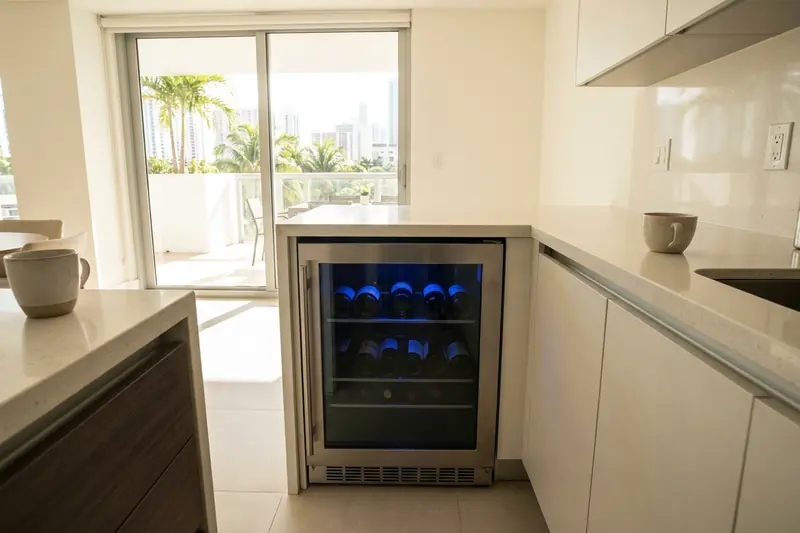
Built-in models breathe through the grille at the front, under the door. Freestanding models vent at the back or sides, and one slid into an undercounter opening runs hot, runs constantly and wears out early.
Dual-zone coolers: when one zone drifts
A dual-zone cooler keeps two compartments at two settings, each with its own sensor and often its own fan or air damper. Some also carry a small heater to hold a zone up to temperature when the room is cool.
If one zone drifts while the other holds, the cause is usually inside that zone: its sensor, fan, damper or door seal. If both creep warm together, look at what they share: the compressor, the condenser and its fan, or the control. Rule out settings first, too: a zone set by mistake, or a display switched to Celsius, can look a lot like a fault.
Condensation on the glass in Miami humidity
A glass door is insulated, usually with two or three panes, but in a humid room its outer surface can still drop below the dew point and fog, most often at the edges. Light fog on a muggy day is not a fault. Heavy fog that never clears points to a door that does not seal, or a cabinet running colder than its setting.
Fog between the panes is different: the seal of the insulated glass has failed, and the glass or the door is replaced. Water pooling inside the cabinet usually comes from a door left ajar, a worn gasket or a blocked drain at the back; a bottle that stops the door from closing does more harm than it looks.
What it is doing, and what that usually means
Both zones warm
Something they share: the compressor, the condenser or its fan, or the control.
One zone drifting
That zone's own sensor, fan, damper or door seal.
Water on the cabinet floor
A door that isn't sealing, a blocked drain or frost melting off the evaporator.
Fog between the glass panes
A failed seal in the insulated glass. The glass or the whole door is replaced.
New rattle or buzz
A fan blade touching frost, a loose part or a worn compressor mount. Worth checking early.
Sealed-system repairs, and when to stop
Leaks, blockages in the refrigerant lines and worn-out compressors are sealed-system work, done by EPA 608 certified technicians. On a built-in wine column, that repair is usually worth doing.
On a small freestanding cooler, a failed compressor or thermoelectric module can cost close to a new unit, and you hear that before any work starts. Fans, sensors, gaskets and controls are worth replacing on almost any cooler.
Before you call
Two checks make the visit more useful.
- Put a thermometer in a glass of water on a middle shelf and read it after a few hours. It tells you more than the display.
- If the cabinet is warming, keep the door shut. A cool, dark closet indoors is a better short-term home for the bottles than a warm kitchen counter.
More from Appliance Repair Doctors
Repairs
Brands, parts and who comes out
We repair built-in wine storage from Sub-Zero, Liebherr, Marvel, U-Line, Miele and Thermador, and freestanding coolers from everyday brands. Appliance Repair Doctors is family-owned, with 15+ years of repair experience, and not affiliated with any appliance manufacturer.
Technicians are background-checked, parts are genuine OEM, our work is insured, and repairs carry a workmanship warranty of up to 6 months. Repairs on Sub-Zero wine storage carry up to 12 months on parts and labor.
Common questions
Asked about wine cooler repair
Can a freestanding wine cooler go under the counter?
What temperature should a wine cooler hold?
Why does my wine cooler run all the time?
Do you repair wine columns built into cabinetry?
Book a technician
Tell us the brand, whether the cooler is built in or freestanding, and what it is doing. Dispatch will call back with a realistic arrival window.
Name, phone and the appliance are enough. Dispatch calls back, and we agree on a realistic arrival window rather than promise one we can't keep.
(786) 807-3854